sunnuntai 1. marraskuuta 2015

Social media

Problem: social media in business

Learning objectives (LO):

1. Which social media platform is suitable for which purpose? 

  • B2B vs. B2C platforms
  • Different tools for different industries
2. Strategy: social media plan

3. Measuring tools
  • Techniques and tools to measure effectiveness

1. Which social media platform is suitable for which purpose? 

  • B2B vs. B2C platforms

  • Different tools for different industries

http://crossroadsprm.com/2013/01/b2b-vs-b2c-social-media-part-ii/
image

Socialbakers' Social Media Reports show the top Pages and Posts per Industry
http://www.socialbakers.com/resources/reports/industry/


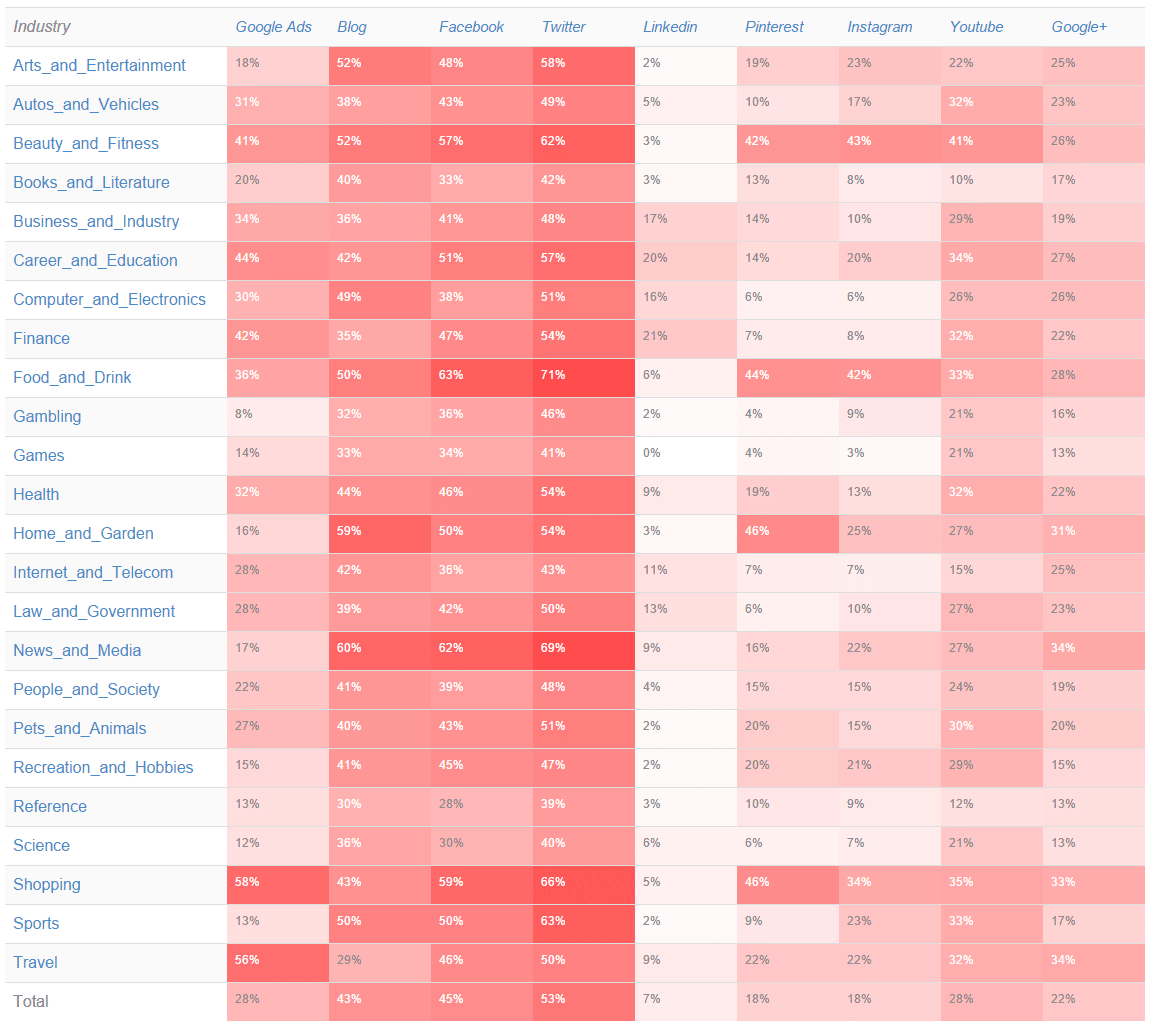
In fact, according to GrowEpic’s data here is a breakdown of percent of companies in an industry that use each social media channel:

  • 45% – Facebook
  • 22% – Google+
  • 18% – Instagram
  • 7% – LinkedIn
  • 18% – Pinterest
  • 53% – Twitter
Here is the full chart with all the industries tracked:
(source)
Social Media Channel Usage By Industry

2. Strategy: social media plan

A social media marketing plan is the summary of everything you plan to do and hope to achieve for your business using social networks. This plan should comprise an audit of where your accounts are today, goals for where you want them to be in the near future, and all the tools you want to use to get there.
In general, the more specific you can get with your plan, the more effective you’ll be in its implementation. Try and keep it concise and don’t make your social media marketing strategy so lofty and broad that it’s unattainable. This plan will guide your actions, but it will also be a measure by which you determine whether you’re succeeding or failing at social media. You don’t want to set yourself up for failure from the outset. (source)

How to make social media plan
(source)
Step 1: Create social media objectives and goals
The first step to any social media marketing strategy is to establish objectives and goals that you hope to achieve. Having these objectives also allows you to quickly react when social media campaigns are not meeting your expectations. Without these goals, you have no means of gauging your success and no means of proving your return on investment.

These goals should be aligned with your broader marketing strategy, so that your social media efforts all drive towards business objectives. If your social media marketing strategy is shown to drive business goals forward, you’re more likely to get executive buy-in and investment. They should also go beyond vanity metrics like retweets or Likes, in favour of more advanced metrics like leads generated, sentiment or website traffic referred. Strive to approach these goals using the SMART approach, meaning they should all be specific, measurable, attainable, relevant and time-bound.

For example:
For Instagram we will share photos that communicate our company culture. We will do this by posting 3 photos a week that will achieve 30 likes plus 10 comments each.


Step 2: Conduct a social media audit
Prior to creating your social media marketing plan, you need to assess your current social media use and how it is working for you. This requires figuring out who is currently connecting to you via social media, which social media sites your target market uses and how your social media presence compares to your competitors’.

Find a social media audit template at  http://blog.hootsuite.com/how-to-create-a-social-media-marketing-plan/

Creating an organized plan will act as a checklist to keep you on track with your social media efforts- covering everything from daily upkeep and weekly tasks to big projects, contests and promotions. (source)

  • Commitment: According to Social Media Examiner, “invest time, energy and resources into [your social media] no matter what. [It] will keep you committed and prepare you to be active and engaged even when you feel like your presence is stagnating.”
  • Determine Goals: Think about realistic goals you’d like to achieve, as well as the steps you’ll need to take in order to get there.  For example, would you like to increase traffic? See more engagement on your site? Determine how you will you go about accomplishing these goals.
  • Do you have an existing fan base?: Are people currently posting videos of your product on YouTube? Are they uploading pins of your product on Pinterest?  Find out if you’re already getting attention somewhere and take advantage of that.
  • Develop a Schedule: Decide how many times you’ll be posting and how often you will be replying to keep up a steady engagement. Everyone wants to create conversations—the important thing is that you find a timely way to always respond.
  • Create an Editorial Calendar:  This will sum up everything you’ll be doing for an entire month. Decide on what kind of content you’ll be posting, how often you’ll be posting it and if there will be a theme for this month.
  • Customization: So you have a nice following on a certain platform now? Mix things up a bit and get creative. Consider creating custom apps on your Facebook page or upload videos to YouTube. Play around with different ideas and see if your spontaneity works for your benefit.
  • Review: According to Social Media Today, after 90-days have passed, it’s important to take the time to evaluate your current results and statistics. “Were your goals met? Did you reach your intended audience?  What worked and what didn’t work?” Adjust what you’re doing to work with these results.


3. Measuring tools

Great article on socialmediaexaminer.com:

5 Ways to Use Metrics to Improve Your Social Media Marketing 


Forbes article "Measuring The Impact Of Social Media On Your Business" (source)

table

Use goal-driven metrics. Set specific goals for each social media campaign and then develop metrics based on those goals. If a social media campaign is designed to generate brand awareness, then engagement is an appropriate metric. However, if a social media campaign is intended to drive purchase, then the conversion rate from visitor to buyer might be a more suitable metric. This insight may seem obvious but there is often a disconnect between goals and metrics.

Demonstrate metric validity. Metrics must be vetted to ensure they are valid—meaning they measure what they are designed to measure. For example, at what point should marketers classify a consumer’s interaction with a company on social media as “engagement”? Is it when a consumer likes or shares a post? Proving metrics requires linkages to key outcomes, customer interviews, and managerial judgment.

Uncover and verify leading indicators. Social media engagement, measured by the number of page views, click-throughs, comments, shares, and likes, is often used as a leading indicator of downstream sales outcomes. Identifying and tracking such leading indicators is valuable as companies can gain an early sense of how well their strategies will pay off.

Create dashboards. Most companies with a social media presence track metrics from multiple sources. As a result, it is helpful to create a social media dashboard that aggregates these different sources and shows a comprehensive view of the company’s or brand’s performance. A dashboard saves monitoring time and ensures that marketers have real-time access to how important metrics are trending.

Develop meaningful benchmarks. Comparing results to meaningful benchmarks provides important context when assessing the impact of social media campaigns. Building a database of social media campaigns and their corresponding outcomes enables your company to develop these benchmarks. Your agency may also be able to provide a broader view of these benchmarks if they have access to a range of campaigns from various companies.

Conduct experiments. To truly understand the impact of social media, companies must be willing to conduct experiments. Small experiments such as pre- and post-tests that measure consumer activity before and after a social media campaign are a useful way of assessing performance. Even better, include a control group that is matched on observable characteristics for comparison to the treatment group. For example, use geo-targeted social media in one city and compare results to a control-group city in which the campaign did not run.

Allocate funds to measurement. According to The CMO Survey, companies spend only 2.3% of their marketing budgets on measuring ROI. Measuring the impact of social media requires investing in metrics. This investment might include dedicated staff, agency partnerships, tools and technology, models, or customer databases.

Consider the cost of ignoring social media. One social media expert we interviewed offered the insight that the inability to perfectly measure social media’s return on investment (ROI) should not limit investments in it. Instead, he encourages his organization to also consider the Cost of Ignoring (COI) social media – “What is the cost to our business of ignoring this new platform?”

Build predictive models. Metrics are often used to analyze what has happened, but they also can be used to predict what is likely to happen depending on the tactics employed, such as spending levels and media placement. To gain the most out of your metrics, leverage them to build predictive models and then plug in different inputs to simulate possible outcomes.

Guide future actions. Measures should ideally be designed to offer developmental feedback. Ask yourself, if your social media campaign is not working, what information do you need to know in order to improve? Build your metrics or add additional metrics to capture this information so you know how to course correct and do better in the future.

Stick with your metrics. Vendors are constantly developing new tools to measure the impact of social media. Nevertheless, marketers should focus on utilizing a handful of tracking tools that fit their goals and have passed important validity hurdles. Be careful not to flit between different metrics as doing so will hinder learning and waste valuable resources.


maanantai 26. lokakuuta 2015

PBL 6 Communication Plan


Learning Objective1: How to select the proper communication plan?


5 common mistakes in communication planning by Nick Durutta

1. Not identifying an effective  goal - an effective goal defines the desired result.

2. Not trusting your research. Conduct research to identify your goal, understand your audience, situation and environment.

3. Not understanding the organization. A situational analysis is useful: what does organization do? where is it going? what does it want to achieve? Resources should support company's strategic goals.

4. Setting poor objectives. As with goals, they should describe the desired outcome.

5. Omitting audience from planning. Involve the audience and act upon their responses.


Mandese J. (2004, P&G review could be far-reaching. Television Week): Communication Planning is a multidimensional view of the marketing mix that includes any advertisement or communication that touches the consumer .

Karen E. Mckenzie and Marla B. Royne (from the artcile "Defining and Understanding Communications Planning): CP is about creating one-to-one, integrated customer experiences that enhance greater consumer interaction to attract new customers and retain loyal ones by strategically delivering a highly targeted marketing message.

Slide share on Marketing Communication Planning process


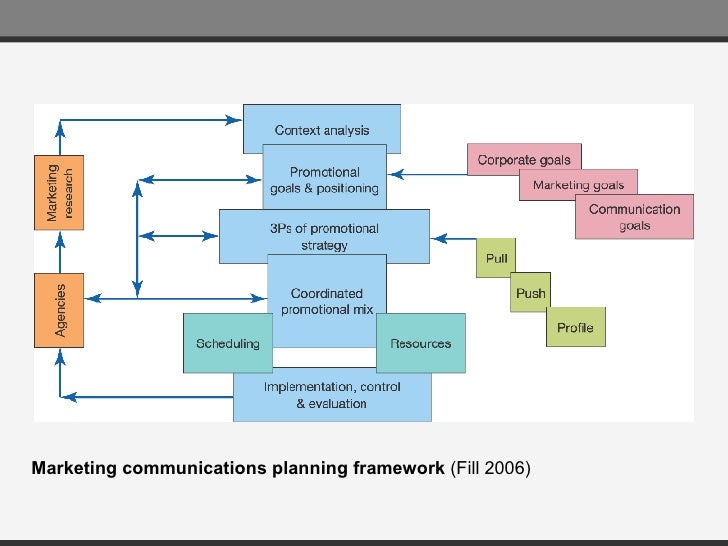
Elements of the plan
  • context analysis
  • marketing communication objectives
  • marketing communication strategy
  • communication methods
  • scheduling
  • resources
  • control and evaluation
  • feedback

Targeting  (source: Chris Fill, Essentials of marketing communications, 2011, p.95)

The following criteria need to be present:

All segments should be
- measurable (is the segment easy to identify and measure?)
- substantial ( is the segment large enough to provide the profit?)
- accessible ( can the buyers be reached with promotional programmes?)
- differentiable ( is each segment clearly different from another so that diffrent marketing mixes are necessary?)
- actionable ( has the organization the capability to reach the segment?)

Learning Objective2: How to implement communication plan successfully?


Case study (from the article Strategic Communication Planning: Why the basics matter more than ever. by Durutta Nick, Communication World Aug2014, p1-1)

In 2006, British supermarket giant Tesco announced its entry into the competitive U.S. market with the opening of hundreds of Fresh & Easy grocery stores in California and Nevada.
The firm conducted research -- a lot of it. It spent years profiling the market. It sent executives to live with families in California to observe how they shop. It built secret test stores and randomly investigated the contents of Americans' refrigerators.
Last year, after six years of struggling to make its venture a success, Tesco announced it was selling Fresh & Easy. It was giving up.
What went wrong?
Timing, for one thing. Tesco launched Fresh & Easy just before a crippling recession hit. But it also ignored its own research, relying on what worked in the U.K., a very different environment from the U.S.
Tesco made its U.S. stores entirely self-service, which American shoppers found off-putting. It sold food in small packages, while U.S. shoppers like buying in bulk to save money. Its stores sold Tesco's unknown private brands in a market that is famously brand-conscious.
Basically, Tesco believed it knew better than its research, and the result was a marketing disaster.

Typical mistakes were made: unrealistic objectives, wrong timing, wrong target audience, wrong tools, unclear messages.


Learning Objective3: Measuring and monitoring


Karen E. Mckenzie and Marla B. Royne (from the artcile "Defining and Understanding Communications Planning):

The basic application of ROI shows how much a campaign costs as compared to the profit  it returns.

Company-specific definitions for ROI may include measuring the number of leads, the ratio of ad cost to ad revenue, the cost per lead, reach/frequency, cost per sale, media post buy analysis, financial value of brand equity, and customer lifetime value.


The basic question is:  Are we providing the right communication means and products to the right people through the right channel at the right moment?

If the answer is yes to all of these questions, it is quite likely that you are having an impact in terms of communication (Source: DG Communication, European Commission)

Article 4(3) of implementing Regulation EC 1828/2006: “The means used for implementing monitoring and evaluating the communication plan shall be proportional to the information and publicity measures identified in the communication plan.”

Which impact are you expecting?

-Outcome I Awareness/knowledge: impact can be assessed in terms of knowledge gains that can be traced to com activities problem: awareness raising is often too vague
-Outcome II Attitude/perception:(Positive) perception of a project or your programme and EU funding in general difficulty: often evaluations of attitudes lack clear objectives; changes cannot be traced back to communication measures
-Outcome III Behaviour:E.g. influence on regional policy (regulations..) Most obvious when things have gone wrong (protests, complaints…) However, behavioural communication impacts can hardly be isolated validly.

Monitoring your communication activities
Events:
- Keep track of participants’lists and contacts (including journalists!) 
- Prepare a questionnaire for feedback or conduct a brief online survey after your event

Online tools:
-Monitor your website hits in connection with certain events, after having sent out a press release etc…
-Social media activities

Publications:
- Keep track of who received your publications (distribution lists) and the number of publications disseminated.
- Get feedback through surveys or focus groups.

MEDIA MONITORING
Media Monitoring and evaluation of media impact
Step 1 -Compile an archive including press clippings and screenshots of websites that mentioned your programme
-If you cover a large programme area (e.g. transnational programmes) you may also think about hiring a professional media monitoring service, although this can be costly
-Keep also a media archive of radio and TV programmes that mentioned your programme
-Set up a library/archive with your projects’ publications
Step 2 -Evaluate the content of the media and its effectiveness (content analysis)

maanantai 5. lokakuuta 2015

PBL 5 Reputation


“It takes many good deeds to build a good reputation, and only one bad one to lose it.”


                                                                                                           Benjamin Franklin


Learning Objective1: How to prepare for a crisis (Pre-)
·       Is it possible to be prepared for a crisis?
o   Why is it important to prepare for potential crises?
·       Recognizing the signs (in which circumstances a crisis possibly occurs?)
 
Learning Objective2: Crisis communication (During)
·       Define the scale of the crisis
·       How to manage the communication during crisis?
o   What to consider? External/ Internal
 
Learning Objective3: Effects of crisis (Post-)
·       How to recover from a crisis?
·       How to hold up the reputation post-crisis? Consider internal and external elements
 
 
A great article about online reputation management on https://blog.kissmetrics.com/guide-to-reputation-management/:

A proactive approach consists of monitoring your public reputation on a regular basis via “social media monitoring.”
Social media monitoring allows companies to gather public online content (from blog posts to tweets, from online reviews to Facebook updates), process it, and see whether something negative or positive is being said affecting their reputation.
Social media monitoring can be both DIY (Google Alert is an example of a free web monitoring tool accessible to anyone) and professional, depending on the size of the business involved.

An article from HBR "Reputation and its risks" here gives practical advice:

Effectively managing reputational risk involves 5 steps:

1) assessing your company’s reputation among stakeholders -  Three questions need to be addressed: What is the company’s reputation in each area (product quality, financial performance, and so on)? Why? How do these reputations compare with those of the firm’s peers?
Various techniques exist for evaluating a company’s reputation. They include media analysis, surveys of stakeholders (customers, employees, investors, NGOs) and industry executives, focus groups, and public opinion polls. Although all are useful, a detailed and structured analysis of what the media are saying is especially important because the media shape the perceptions and expectations of all stakeholders.
2) evaluating your company’s real character,
3) closing reputation-reality gaps,
4) monitoring changing beliefs and expectations,
5) putting a senior executive below the CEO in charge - the CEO has to give one person responsibility for making these things happen. Obvious candidates are the COO, the CFO, and the heads of risk management, strategic planning, and internal audit.

 
Learning Objective1: How to prepare for a crisis (Pre-)
·       Is it possible to be prepared for a crisis?
o   Why is it important to prepare for potential crises?
·       Recognizing the signs (in which circumstances a crisis possibly occurs?)
 
Paul Argenti "Corporate Communication", fifth edition: 
"A crisis is a major catastrophe that may occur either naturally or as a result of human error, or even malicious event. It can include tangible devastation, such as the destruction of lives or assets, or intangible devastation, such as the loss of an organization's credibility or other reputational damage. The latter outcomes may be the result of management's response to tangible devastation or the result of human error. A crisis usually has significant actual or potential financial impact on a company, and it usually affects multiple constituencies in more than one market."
 
Crisis characteristics:
1) the element of surprise (Philip Morris found carcinogens in its filters) leads to loss of control!
2) insufficient information (no facts - a lot of explaining)
3) the quick pace of events (things escalate rapidly)
4) intense scrutiny (media spotlight, Martha Stewart)
 
Organizations tend not to understand their vulnerability until after a major crisis occurs. Lack of preparation can make crises even more severe and prolonged when they do happen.
3 case studies:
1982 - Johnson & Johnson's Tylenol Recall
1990 - the Perrier Benzene Scare
1993 - Pepsi-Cola's Syringe Crisis
 
With personal Computers and Internet organizations face new crises online - data theft and beyond. Besides the damages businesses must cover for the affected customers, doubts about online security can arise doubts in corporate reputation's of many online retailers and bänks. (Argenti, p.257-267)
 
How to prepare for a crisis:
First, understand that today every organization is at risk.
Communications managers can use information about what has happened to unprepared organizations in earlier crises.
 
Assess the risk for your organization. Some industries are more prone than others. Publicly traded companies are at risk because in case of a crisis they face a selloff in the stock. Privately held companies should worry about the possibility to lose goodwill, which can affect sales.
 
Then brainstorming session that includes the most senior managers in the organization and the representatives. The goal is to develop ideas about potential crises, and decide which of them have most potential to occur.
 
Determine which constituencies would be most affected by the crisis and pay attention to the most significant groups.
 
Next steps are set communication objectives for potential crises, analyze channel choice, assign a different team to each crisis, plan for centralization.

 
Learning Objective2: Crisis communication (During)
·       Define the scale of the crisis
 
Factors that shape the reputational threat
 
The threat is the amount of damage a crisis could inflict on the organization's reputation if no action is taken. Three factors in the crisis situation shape the reputational threat: (1) initial crisis responsibility, (2) crisis history and (3) prior relational reputation.
 
Initial crisis responsibility is a function of stakeholder attributions of personal control for the crisis by the organization – how much stakeholders believe organizational actions caused the crisis (Coombs, 1995). Research has consistently demonstrated that increased attributions of crisis responsibility by stakeholders produce lower reputational scores among those same stakeholders. The reputational threat to an organization increases as stakeholders' attributions of crisis responsibility to the organization intensifies (Coombs, 1998; Coombs and Holladay, 1996, 2002, 2004).
 
Situational crisis communication theory's research has identified three crisis clusters based upon attributions of crisis responsibility by crisis type: (1) the victim cluster has very weak attributions of crisis responsibility (natural disasters, workplace violence, product tampering and rumor) and the organization is viewed as a victim of the event; (2) the accidental cluster has minimal attributions of crisis responsibility (technical-error accident, technical-error product harm and challenge) and the event is considered unintentional or uncontrollable by the organization and (3) the intentional cluster has very strong attributions of crisis responsibility (human-error accident, human-error product harm and organizational misdeed) and the event is considered purposeful (Coombs and Holladay, 2002).
 
Crisis history is whether or not an organization has had a similar crisis in the past. According to Attribution Theory, a history of crises suggests an organization has an ongoing problem that needs to be addressed (Kelley and Michela, 1980; Martinko et al., 2004). Prior relational reputation is how well or poorly an organization has or is perceived to have treated stakeholders in other contexts. Prior relational reputation is unfavorable if the organization has a history of treating stakeholders badly (Porritt, 2005). An unfavorable prior relational reputation suggests an organization shows little consideration for stakeholders across a number of domains, not just in this crisis.
 
Crisis history and prior relational reputation have both a direct and indirect effect on the reputational threat posed by the crisis. Either a history of crises or an unfavorable prior relational reputation intensifies attributions of crisis responsibility thereby indirectly affecting the reputational threat. Moreover, the two factors have a direct effect on the reputational threat that is separate from crisis responsibility (Coombs, 2004a, 2004b).
 
·       How to manage the communication during crisis?
o   What to consider? External/ Internal
 
Crisis response strategies
 
Primary crisis response strategies
 Deny crisis response strategies
  Attack the accuser: Crisis manager confronts the person or group claiming something is wrong with the organization.
  Denial: Crisis manager asserts that there is no crisis.
  Scapegoat: Crisis manager blames some person or group outside of the organization for the crisis.
 Diminish crisis response strategies
  Excuse: Crisis manager minimizes organizational responsibility by denying intent to do harm and/or claiming inability to control the events that triggered the crisis.
  Justification: Crisis manager minimizes the perceived damage caused by the crisis.
 Rebuild crisis response strategies
  Compensation: Crisis manager offers money or other gifts to victims.
  Apology: Crisis manager indicates the organization takes full responsibility for the crisis and asks stakeholders for forgiveness.
 
Secondary crisis response strategies
 Bolstering crisis response strategies
  Reminder: Tell stakeholders about the past good works of the organization.
  Ingratiation: Crisis manager praises stakeholders and/or reminds them of past good works by the organization.
  Victimage: Crisis managers remind stakeholders that the organization is a victim of the crisis too.

Source: http://www.palgrave-journals.com/crr/journal/v10/n3/fig_tab/1550049t2.html#figure-title

 
What to include in a formal plan:
 
- a list of whom to notify in an emergency
- an approach to media relations
- a strategy to notifying employees
- a location to serve as crisis headquarters
- a description of the plan
 
(Source: Argenti, p.272-278)


Crisis  communications should be coordinated by the corporate communication function, and communications professionals should be involved in crisis planning and crisis management. Ideally, a wider group of managers from throughout the organization - including the senior management spokesperson who will be facing the public - are included in all plannings of such events, in other words in-house collaboration.
 
Lawers may present a problem because they operate with a different agenda than communications professionals and do not consider how actions may be perceived By the public. A recent study states: "legal dominance is shortsighted and potentially costly". (Argenti, p.61-62)
 
The most important steps to take when communicating during the crisis:
 
Step 1: get control of the situation
Step 2: gather as much information as possible
Step 3: set up a centralized crisis management center
Step 4: communicate early and often
Step 5: undertstand the media's mission in a crisis
Step 6: communicate directly with affected constituents
Step 7: remember that business must continue
Step 8: make plans to avoid another crisis immediately
 
Source: Argenti p.279-282
 
Learning Objective3: Effects of crisis (Post-)
·       How to recover from a crisis?
·       How to hold up the reputation post-crisis? Consider internal and external elements
 
The diminish crisis response strategies argue that a crisis is not as bad as people think or that the organization lacked control over the crisis. If crisis managers lessen an organization's connection to the crisis and/or have people view the crisis less negatively, the harmful effects of the crisis are reduced. Managers need solid evidence to support these claims and even then might fail. Failure occurs when the news media or, in the case of online-oriented crises, people posting messages reject the crisis manager's frame and continue using a different frame. Stakeholders will be given competing frames and will select the frame provided by the source they find most credible. Diminish strategies are most effective when reinforcing existing crisis frames. Excuse strategies, lack of intent and/or volition can be used to reaffirm a crisis situation as residing in the accidental cluster. The value in reinforcing such a frame is that an accidental crisis is much easier and less expensive to manage than an intentional crisis (Coombs and Holladay, 2002, 2004).
 
To change perceptions of the organization in crisis, managers present new, positive information about the organization and/or remind stakeholders of past good works by the organization. The key is to offset the negatives from the crisis with current or past good works. Rebuild strategies are the main avenue for generating new reputational assets. Rebuild strategies attempt to improve the organization's reputation by offering material and/or symbolic forms of aid to victims. The crisis managers say and do things to benefit stakeholders and thereby take positive actions to offset the crisis. Offering compensation or a full apology both are positive reputational actions. The rebuild strategies are used for crises that present a severe reputational threat such as intentional crises or accidental crises coupled with a crisis history and/or unfavorable prior relationship reputation.
 
Bolstering offers a minimal opportunity to develop reputational assets. Managers who have had positive relationships with stakeholders can draw upon that goodwill to help protect the organizational reputation, praise stakeholders for their efforts during the crisis as a means of improving relationships with them or draw sympathy from being a victim of the crisis. Praising stakeholders generates some goodwill and being cast as the victim evokes sympathy for the organization. Reminder, another bolstering strategy, uses past good works to counter-balance the current negatives from the crisis. The reminder strategy demands that there are good past works from which to draw. All bolstering strategies are best used as supplements to the three primary strategies and adjusting information.
 
A crisis will create negative affect, especially the intentional crisis cluster. Stakeholders become angry and may even enjoy seeing the organization suffer. Deny eliminates negative affect if people accept there is no crisis. Adjusting information and rebuild strategies are the most effective ways to reduce negative affect. Part of adjusting information is the expression of concern for victims. Expressions of concern themselves help to reduce negative affect. Expressing concern for victims (adjusting information) and reinforcing this compassion through compensation and/or a full apology serve to blunt feelings of anger (Coombs and Holladay, 2005). A crisis can also evoke sympathy for the organization. The victimage strategy serves to reinforce the belief that the organization deserves sympathy.